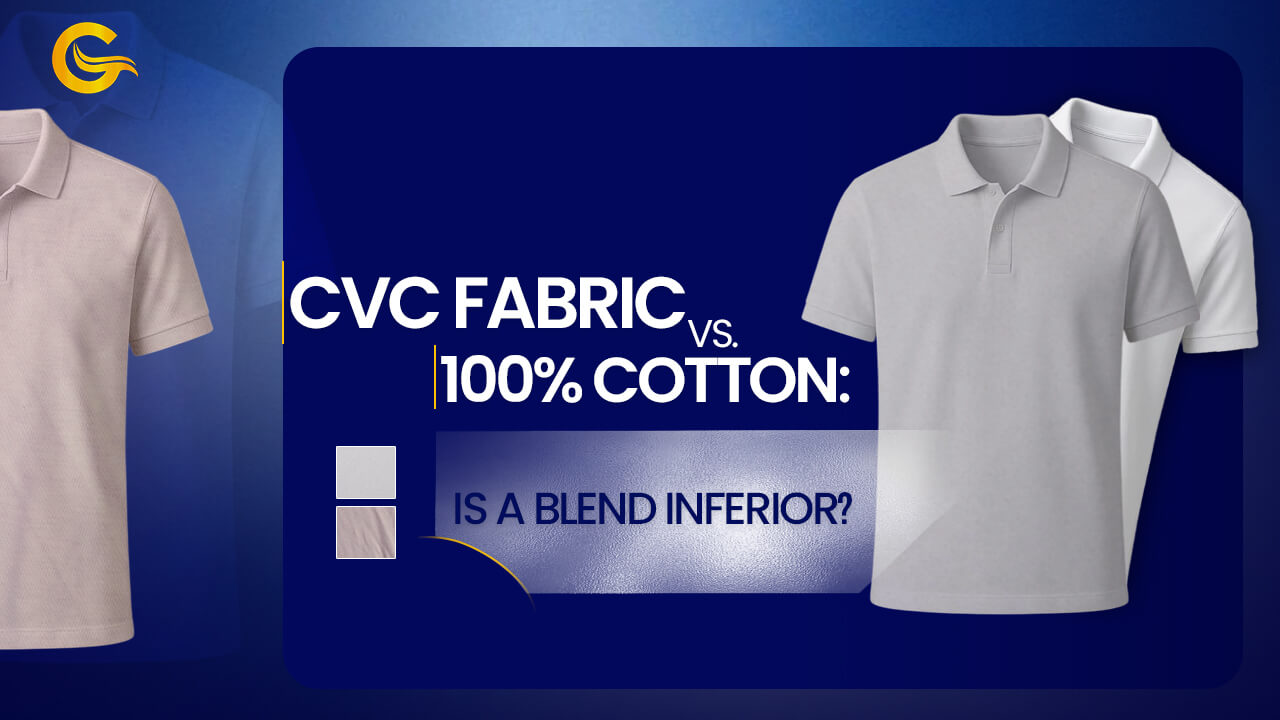
If you’ve spent any time shopping for uniform fabric, workwear, or everyday cotton pieces, you’ve probably come across the label “CVC” and wondered what it actually means — and whether it’s a step down from “real” cotton. It’s a fair question. A lot of buyers assume that anything blended must be the compromise option, chosen to cut costs rather than improve the fabric. That assumption isn’t quite right, and it’s worth unpacking before you rule CVC out.
What Is CVC Fabric Made Of?
CVC stands for Chief Value Cotton, and it’s a fabric blend that’s majority cotton — typically around 60% cotton to 40% polyester — rather than a mostly-synthetic fabric with a bit of cotton mixed in. That ratio is the reason CVC keeps much of the softness and breathability people associate with pure cotton, while picking up a few things cotton alone doesn’t do as well, like resisting shrinkage and holding its shape wash after wash.
How Is CVC Cotton Different From Regular Cotton?
The difference isn’t really about which one is “better” — it’s about what each is suited for. Pure cotton has an edge in softness, especially for anything worn directly against skin for long stretches. CVC trades a small amount of that softness for more durability and dimensional stability, which is why it shows up so often in workwear and pieces that need to survive frequent industrial washing without losing their shape. A blend isn’t automatically worse — it’s a different set of trade-offs, chosen deliberately for a different job.
Which Products Is CVC Fabric Best Suited For?
CVC tends to perform best in garments that face repeated, heavy-duty washing and need to hold their shape over months of use — think polo shirts, work shirts, and everyday uniform pieces. It’s less suited to garments where maximum softness against skin is the priority, like fine baby wear, where 100% cotton still has the edge.
Can CVC Fabric Be Used for Uniforms and Workwear?
Yes — this is arguably where CVC does its best work. Uniforms and workwear need to survive frequent wash cycles without shrinking, sagging, or fading, and CVC’s polyester content is built for exactly that kind of wear. If your project falls into this category, CVC isn’t a cost-cutting substitute for cotton; it’s often the more practical choice.
If you’re weighing fabric options for a uniform program, our guide on choosing fabrics for uniforms and hospitality wear walks through how different blends perform under real working conditions, which is useful context alongside this comparison.
CVC Fabric vs. 100% Cotton: What’s the Real Difference?
In short: 100% cotton wins on softness and breathability, while CVC wins on shape retention and shrink resistance. Neither is the universally “correct” choice — a soft T-shirt meant to feel as light as possible is a different use case from a uniform shirt that needs to survive a hundred wash cycles, and the right fabric depends on which of those jobs you’re actually asking it to do.
If you want to see CVC cotton up close before deciding, you can check the CVC Cotton Jersey listing in our catalog, or browse the wider fabric shop to compare it side by side with 100% cotton options.